“The rock and the tree”
The Dispossessed“The rock and the tree” names a childhood thought experiment in which a thrown stone seems unable to reach its target because it must always cross another halfway point. The image introduces Shevek’s habit of seeing a problem for himself, and it becomes a durable motif linking an early classroom demonstration to his later isolation in space, where the rock no longer moves at all.
The Classroom Thought Experiment
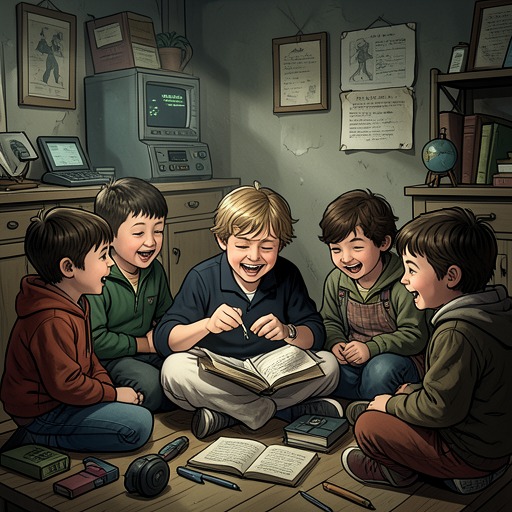
As a boy, Shevek presents his idea to a group of children. He asks them to imagine throwing a rock at a tree, then explains that the rock must pass through the halfway point between its starting place and the tree, and then through the halfway point of the remaining distance. However far it travels, another halfway point remains. He sketches the throw and the tree on a slate, making the abstract problem tangible enough that the children giggle at his drawing of a holum tree.
Shevek’s explanation is not simply that the rock moves slowly or that the throw misses. His claim is more unsettling: if the rock must always cover half the distance still left, it can never arrive. When a girl asks why it cannot reach the tree, he restates the reasoning plainly. Asked who gave him the idea, he answers that nobody did; he had seen it for himself. The scene establishes both the logic that has caught his attention and the independence of his thinking.
A Child’s Idea Meets Authority
The classroom response makes the thought experiment a small encounter between curiosity and institutional judgment. The director, a young man, interrupts Shevek to ask the other children whether they think the idea is interesting, then suggests that Shevek simply aimed badly. That reply shifts the discussion away from the reasoning: it treats the puzzle as a failed throw rather than engaging with the claim about endless division.
The children’s reactions are more open-ended. They giggle at the drawing, but one of them asks a direct question about the rock’s inability to arrive. The contrast matters: the problem attracts attention even as the adult in charge tries to close it down. Shevek continues, beginning to say that he thinks he sees how the rock actually does move. The passage therefore presents the classroom episode not as a completed proof, but as an early glimpse of a mind pursuing a question beyond the explanation its audience is ready to accept.
From the Moving Stone to the Still One
The image gains a second resonance during Shevek’s journey aboard the Mindful. Watching his world recede on a screen, he experiences terror as the familiar landscape becomes a sphere falling away in blackness. The rupture leaves him unable, for a time, to understand an answer from the person beside him: his attention is narrowed to total isolation.
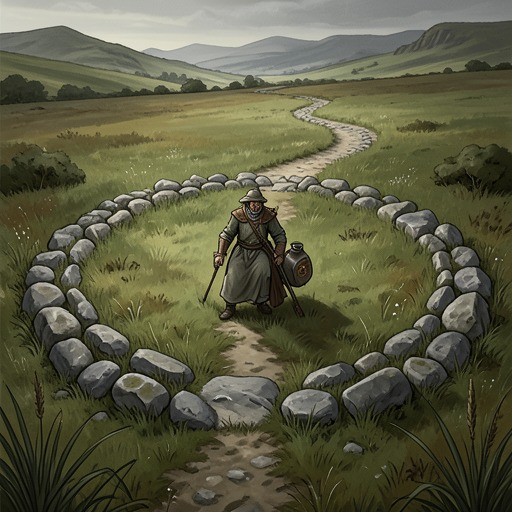
Later, during a feverish vacancy in which past and future seem to disappear, Shevek imagines himself as time, as river, arrow, and stone. Yet the stone does not move: “The thrown rock hung still at midpoint.” The childhood puzzle had treated the halfway point as an obstacle that motion could never overcome; the later passage turns that image into a figure for suspended experience, where time does not pass and Shevek cannot move. The recurrence connects a child’s abstract question about motion with the adult’s bodily and psychological dislocation, without making the two episodes identical.
Significance of the Expression
The expression holds together movement and arrest. In the classroom, Shevek’s rock is defined by its relation to a target it cannot reach; aboard the ship, the rock hangs at the midpoint, cut off from any arrival. The image thus acquires force through repetition with difference: first it gives form to a mathematical paradox, then it evokes the paralysis of a self isolated from its world.
The scene also foreshadows Shevek’s larger intellectual character without claiming that the childhood explanation already contains his mature theory. What it establishes is a method: he invents his own question, tries to make it visible to others, and keeps pursuing it when authority dismisses it. “The rock and the tree” is therefore both a memorable example of his early reasoning and a compact image of the distance between a thought’s movement and the social world’s willingness to follow it.